2026 IPS Voters Guide
The next general election is
Tuesday November 3, 2026
The next general election is
Tuesday November 3, 2026
/gl59w9tefqhkao4fyr32d7oaweyh)
This IPS voters guide is for citizens of Indianapolis who want to learn more about IPS Board of Commissioners races. We've compiled information regarding the organizations influencing the election, candidates for traditional public schools, and the upcoming referendum.
Prior to voting check your registration status or register to vote if it is your first time.
👉🏽The registration deadline for the November 2026 election is Monday, October 5, 2026.
👉🏽Indiana has early voting and absentee ballot options
👉🏽If you prefer to vote on election day, know where your available poling places are located.
👉🏽Research the candidates and the ballot measures before heading to the polls.
Check out these helpful resources:
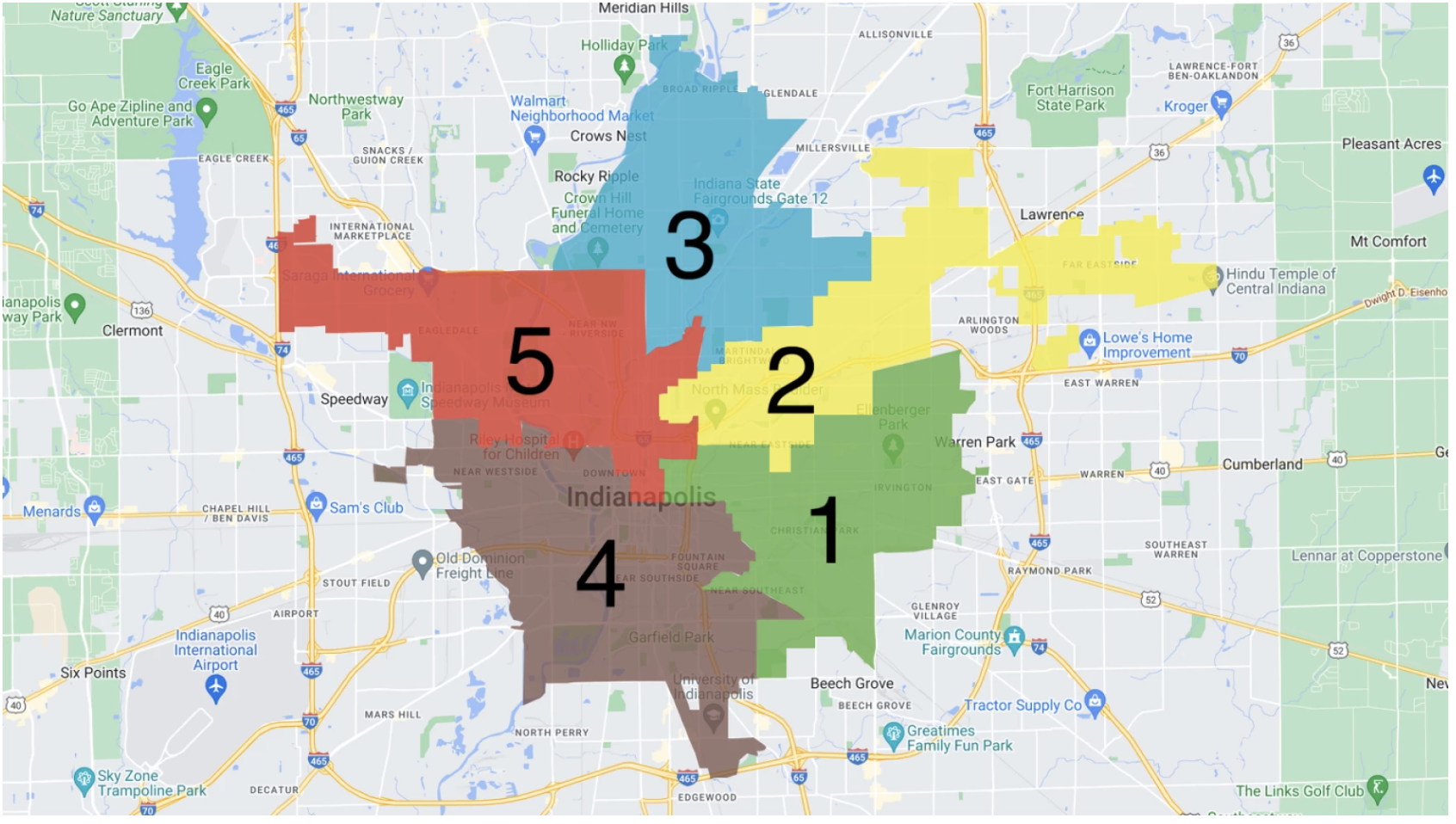
Five of the seven seats are available for election on the Indianapolis Public Schools (IPS) board. The candidate filing deadline for these seats was on June 18th, 2026. The 15 candidates are now set to appear on the November ballot.
District 2 (two candidates)
District 3 (four candidates)
District 4 (two candidates)
District 5 (three candidates)
At-Large (four candidates)
All eyes are on the IPS Commissioners races because the elected officials will have a role in deciding the future of IPS. Because of a new state law that has cut funding to public education, IPS is being asked to do more with less. This is especially true since the district must cost share with public charter schools, and because of the funds diverted to vouchers. These challenges are not new, and are reflective of a decades long relationship with the charter school movement in Indiana.
Here is a list of organizations that have a vested interest in the outcome of IPS Board of Commissioners races. This list is not exhausted and information will be updated as we learn more.
Indianapolis Public Schools (IPS)
Incorporated in 1853, IPS is the oldest school district in Indianapolis and serves over 30,000 students. IPS employs 3,700 employees, 47 elementary schools, 10 middle schools, and 12 high schools inclusive of Innovation Schools, Neighborhood Schools, and Charter Schools.
Relevant Links:
Indianapolis Public Education Corporation (IPEC)
Known as IPEC, the Indianapolis Public Education Corporation is a municipal corporation established by state law. Members of this corporation are appointed, not elected, by the Mayor. The current appointees were selected by Major Joe Hogsett. The corporation is designed to oversee transportation and facilities across traditional public schools and charter schools within IPS boundaries.
Relevant Links:
Indianapolis Local Education Alliance (ILEA)
The Indianapolis Local Education Alliance is a city-led group that was charged by the general assembly to review data and craft a plan to address facilities and transportation management for schools in the IPS district boundaries. Although the outcomes were predetermined, the alliance was designed to develop and report on recommendations for the district. IPEC was created as an outcome of this alliance.
Relevant Links:
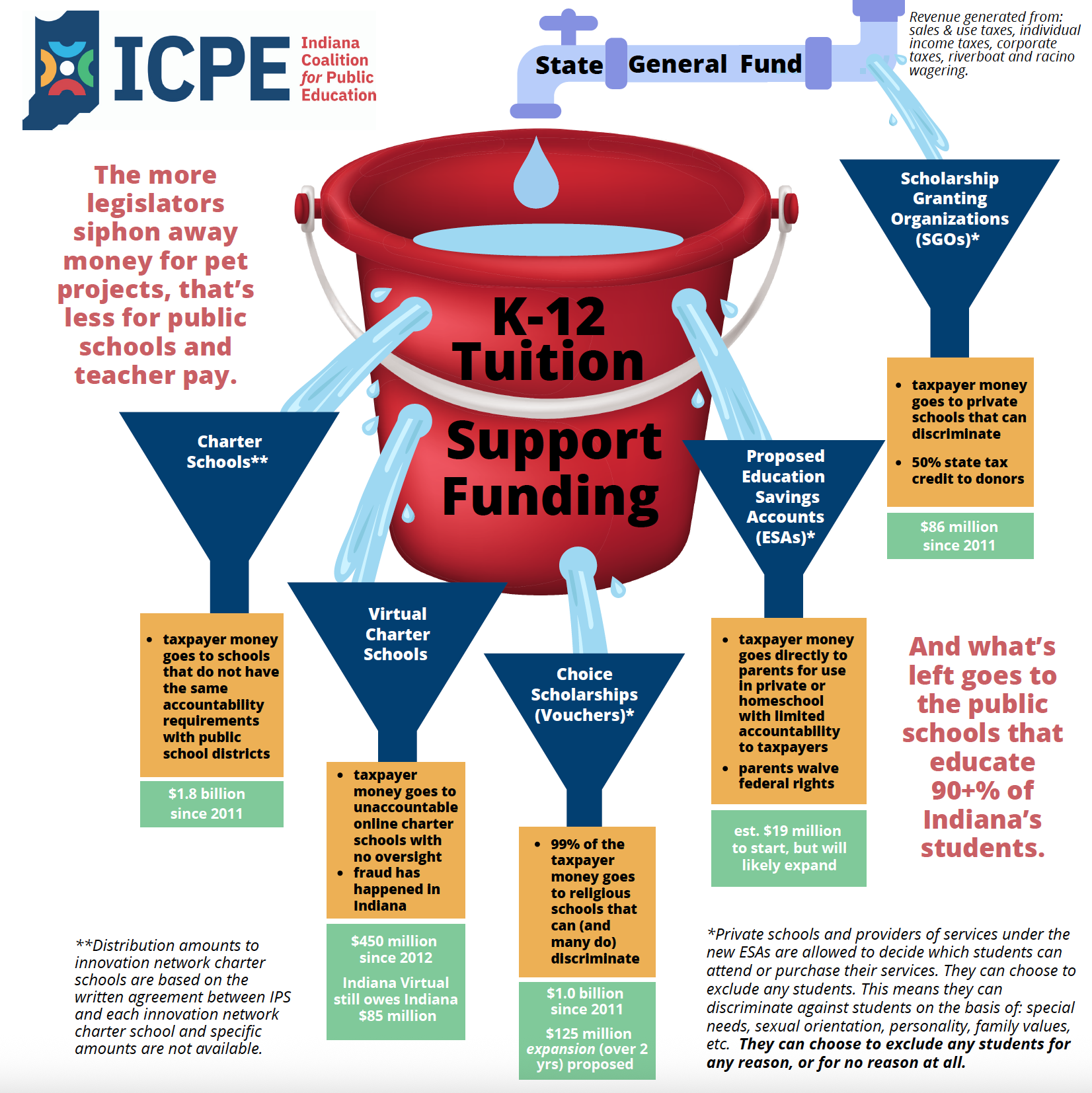
Traditional public schools are publicly funded institutions that promote the rights of all children to receive high quality education regardless of demographics or ability. Enabled by tax-payer rights, these institutions are held accountable to their communities and governed by elected board members. Traditional public schools have been extensively researched and are proven to outperform other public school types when all elements of comparison are the same (i.e. when comparing similar class sizes or school enrollment totals).
These organizations support traditional public schools.
Fully Funded Fully Public (FFFP)
Fully Funded Fully Public is a campaign organized by the Central Indiana Democratic Socialists of America. The campaign is designed to strategically fight for the protection of public education against privatization.
Relevant Links:
Indiana Coalition for Public Education (ICPE)
The Indiana Coalition for Public Education is a non-partisan organization designed to advocate for high quality education across Indiana. Their vision consists of equitable and well funded public schools that are accessible to all children.
Relevant Links:
Indiana School Boards Association (ISBA)
The Indiana School Boards Association is a non-profit organization that offers resources to empower school boards to achieve highly effective governance. They offer retreats, trainings, and consultations and are governed by a 14-member board of directors.
Relevant Links:
Indiana State Teachers Association (ISTA)
Established in 1854, the Indiana State Teachers Association was formed as an outcome of advocacy work in support of a statewide public school system in Indiana. Since formation, ISTA has worked on behalf of teachers to address issues like credentialing, professional development, and salary. Their mission is to sustain the legacy of free public education open to all communities across the state.
IPS Parent Council (IPSPC)
The IPS Parent Council is a parent-run organization designed to advocate for district-run public schools in Indianapolis.
Relevant Links:
Charter schools are publicly funded institutions that are run independently by non-profit boards. First passed into law in 2001 by Governor Frank O'Bannon, charter schools in Indiana are seen as an alternative to traditional public schools because they operate with more flexibility. Specifically, they are exempt from many of the state laws that govern schooling like school meals, calendars, transportation, class size requirements, and teacher licensure laws because they lack publicly elected oversight.
While IPEC is suggested to offer some guardrails for charter schools, many will continue to receive unfair advantages allowing them to expand and siphon resources from traditional public schools. Charter schools tend to have significantly more underserved and economically disadvantaged students, admit fewer students with special needs, and often are segregated by race and class.
These organizations support charter schools.
Indiana Charter School Network (ICSN)
The Indiana Charter School Network is a network of dues-paying members designed to develop policy positions and influence policymakers to ensure charter schools are well represented at the state level.
Relevant Links:
Indiana Charter Innovation Center (ICIC)
The Indiana Charter Innovation Center is an organization that advocates on behalf of charter schools to maximize funding and minimize regulations. Their vision is to see to Indiana being the national leader and model for charter schools.
The Mind Trust
Founded in 2006, the Mind Trust is a non-profit organization established with funding from the Walton Family Foundation, Michael and Susan Dell Foundation, the Richard M. Fairbanks Foundation, and other billionaires. The Mind Trust has partnerships with organizations like Teach for America and TNTP (formally known as The New Teacher Project) to increase the number of educators available in schools. They also oversee enrollment systems like Enroll Indy OneMatch. Mind Trust's purpose is to grow public charter schools across the nation with the intention of better serving Black, Latino, or low-income students. However, they have received extensive criticism and are viewed as preying on these populations while their corporate leaders turn public education into a source of profit.
Relevant Links:
Rise Indy (Rise)
Rise Indy is a non-profit political action committee launched in 2019. The goal of Rise Indy is to ensure all Indianapolis students are prepared for graduation and beyond. However, the organization has been seen as disingenuous because of their proximity to charter school advocates and Republican philanthropists.
Relevant Links:
Stand for Children (Stand Indiana)
Stand for Children is a non-profit organization established in 2011 with seed money from the Mind Trust. Stand Indiana is designed to advocate for education policies in Indiana, and their focus has been on electing education candidates, partnering with parents and communities, and creating a brighter future for all children. However, similar to the Mind Trust, critics believe Stand Indiana is eroding public education and aims to dismantle the IPS system.
Relevant Links:
👉🏽 IPS Direct Managed - Traditional district-run public schools fully operated, staffed, and managed but IPS without an innovation agreement. These schools follow IPS policies and oversight structures. These schools are overseen by the IPS Board of Commissioners and are a part of the Local Education Agency, or the legal entity responsible for compliance with state and federal law.
👉🏽 IPS Innovation (in Local Education Agency) - Schools that are a part of the IPS district but are operated under innovation agreements that give them certain freedoms and flexibilities in terms of budgeting, programming, and hiring. These schools use IPS facilities and receive IPS transportation services. These schools are not considered charters.
Ex: Edison
👉🏽 IPS Innovation Charter - Schools that are a part of the IPS Innovation Network but are run by charter operators and overseen by charter authorizers. Some of these schools use IPS facilities and receive IPS transportation services under innovation agreements. These schools have their own legal agency or district.
Ex: KIPP and Herron
👉🏽 Independent Charter - These schools are run by charter operators and overseen by charter authorizers. They have no formal affiliation with IPS.
Ex: Cold Springs and IMSA
/5y0lrd6ip8ige0eeiu0jgmtrrjc2)
/weuo4t2feoxj2xt7nucqcadw47fe)
/baumtnszn8jnymof9i9aeg3jxmnr)
/0szdfgrnz2d4mxc1oh5wbq2frvwr)
/8vh810bkj989cjegr6022vb3t1kw)